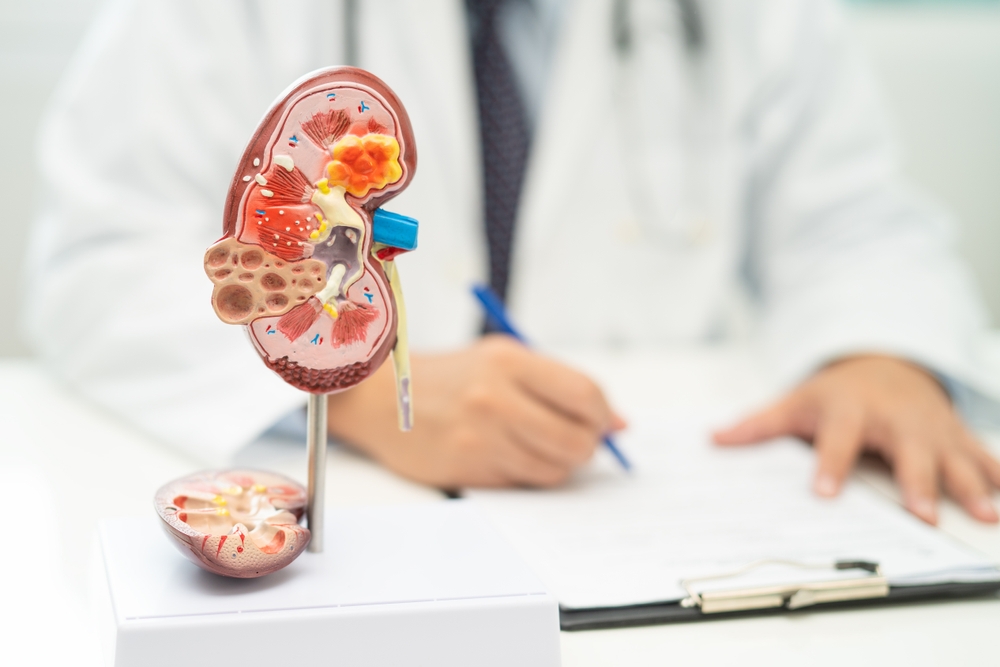
Kidney stones rank among the most common and most painful conditions a person can face, yet many people know surprisingly little about them until one strikes.
A kidney stone forms when minerals and salts in urine, including calcium, sodium and uric acid, clump together into hard deposits. Some stones stay as small as a grain of sand and pass unnoticed. Others grow large enough to block the flow of urine, a development that can trigger sharp pain and, in rare cases, larger complications. Roughly one in ten people will develop a kidney stone at some point, with the condition appearing most often in men in their thirties and forties.
What stones feel like
The hallmark symptom is a deep, aching pain in the lower back or side, often described as coming in waves rather than staying constant. That pain can radiate toward the groin as a stone moves through the urinary tract. Other warning signs include blood in the urine, a burning sensation while urinating, nausea, fever or a persistent urge to urinate even when little comes out. Smaller stones sometimes cause no symptoms at all, passing quietly on their own.
Doctors generally rely on a combination of urine tests, blood work and imaging such as CT scans or ultrasounds to confirm a diagnosis and determine a stone’s size and location.
Why stones form
Most kidney stones fall into one of four categories, and each has a different root cause. Calcium based stones, the most frequent type, tend to develop in people who eat foods high in oxalates or low in calcium while not drinking enough fluids. Uric acid stones are linked to diets heavy in animal protein. Struvite stones typically follow urinary tract infections, and in severe, recurring cases can grow into large formations called staghorn stones that require surgical removal. A smaller group of cases stem from cystinuria, an inherited disorder that causes a buildup of the amino acid cystine.
Certain health conditions raise the odds of developing stones, including diabetes, obesity, gout, high blood pressure and inflammatory bowel disease. Family history plays a role too, along with dehydration, high sodium diets and, somewhat counterintuitively, high doses of vitamin C supplements.
Treatment options for stones
Many small stones pass on their own within one to three weeks, sometimes with the help of medication that relaxes the ureter or manages pain and nausea along the way. Physicians often recommend patience and hydration for stones under four millimeters, since roughly 80% of all kidney stones eventually pass without intervention.
Larger stones, or ones causing infection or blockage, usually require a procedure. Shockwave lithotripsy breaks stones apart using sound waves directed from outside the body. Ureteroscopy involves threading a thin scope through the urinary tract to remove or fragment a stone directly. For the largest or most stubborn cases, doctors may use percutaneous nephrolithotomy, a minimally invasive surgery performed through a small incision in the back.
Preventing a repeat
Anyone who has had one kidney stone faces a meaningfully higher risk of developing another, which makes prevention a long term project rather than a one time fix. Staying well hydrated remains the single most effective habit, alongside cutting back on sodium, sugar and animal protein. Interestingly, dietary calcium from food appears to lower stone risk, even though calcium supplements can raise it.
Kidney stones are not fatal, and most people who develop one go on to live entirely normal lives. Still, doctors recommend seeing a provider at the first sign of symptoms, since untreated blockages can eventually strain kidney function over time. Severe, unbearable pain warrants an emergency room visit rather than a wait and see approach.
This is general health information and is not a substitute for medical advice. Anyone experiencing symptoms of kidney stones should consult a healthcare provider.