Most young adults are reasonably good at taking care of their bodies. They work out, manage their stress and try to eat well. But there is one part of physical health that rarely makes it onto anyone’s wellness checklist, and audiologists say the oversight is creating a problem that shows up quietly and builds over years before most people notice it is happening.
Noise-induced hearing loss is remarkably common. The Centers for Disease Control and Prevention estimates that roughly 17 percent of adults between 20 and 69 already have permanent hearing damage from excessive noise exposure. Unlike age-related hearing loss, which is a natural part of getting older and is influenced by genetics and certain medical conditions, noise-induced hearing loss is largely preventable. The challenge is that most people are not taking the steps that would prevent it.
The stakes are higher than many people realize. Research has identified hearing impairment as one of the most significant modifiable risk factors for dementia. A large-scale study involving more than 168,000 participants found a meaningful association between poor hearing and diminished cognitive function. The relationship is correlational rather than causal, but it is consistent enough to be taken seriously.
Wear hearing protection in loud environments
One of the most effective and most ignored forms of ear protection is also one of the simplest. Earplugs are not just for construction workers. Concerts, sporting events, motorcycle rides and even lawn mowing can expose ears to sound levels capable of causing damage in as little as five to fifteen minutes depending on the intensity.
The reluctance to wear ear protection at concerts is understandable but misplaced. A generation of well-designed earplugs now exists specifically for music listening, engineered to reduce volume without distorting sound quality. The music remains clear and full, simply brought down to a safer level. For louder but less nuanced environments, standard foam earplugs from any hardware store offer solid protection when inserted correctly.
Proper insertion matters. Rolling the plug into a narrow cylinder, gently pulling the top of the ear upward to straighten the canal and pressing the plug in as far as is comfortable ensures that the protection actually works rather than sitting uselessly at the entrance of the ear.
Use a decibel meter to monitor your environment
Sound level awareness is a practical and underused tool. Free decibel meter apps are widely available for smartphones and give an immediate read on whether the environment around you has crossed into a range where protection is warranted. Sounds above 70 decibels carry a risk of hearing damage with prolonged exposure, according to the CDC.
For Apple Watch users, the built-in Health app includes an environmental sound level feature that tracks decibel exposure over time and can reveal patterns that might not be obvious in the moment. Knowing that your regular subway commute or your favorite gym playlist is consistently putting you over a safe threshold is information worth having.
Stop using cotton swabs inside your ears
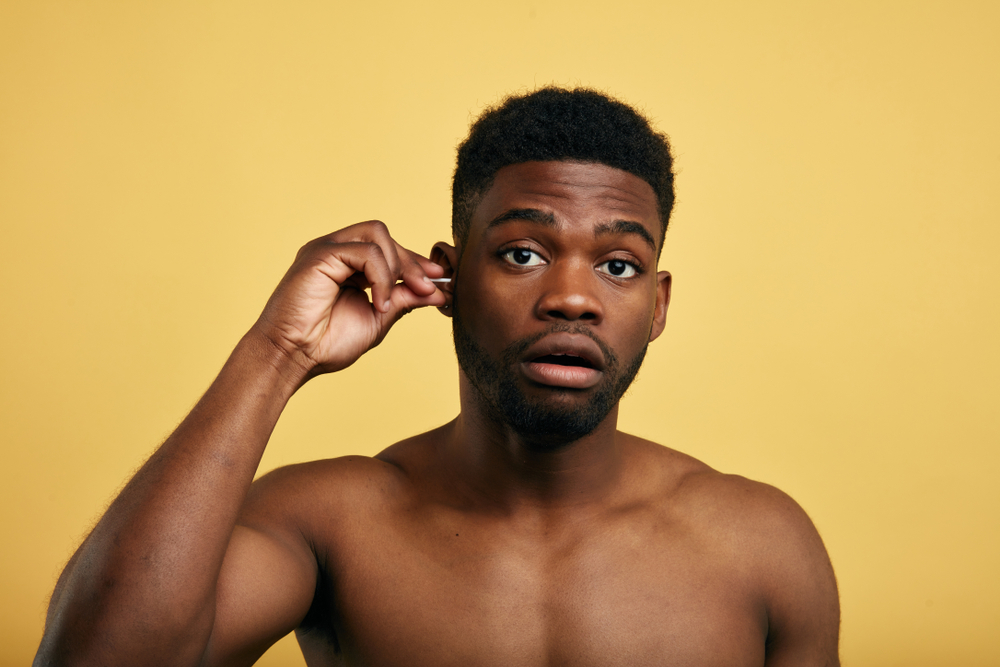
This one surprises people. The ear canal is self-cleaning by design. The skin lining it is uniquely structured to migrate outward, carrying debris with it naturally. Pushing a cotton swab inside disrupts that process, compacting wax deeper into the canal rather than removing it. Impacted wax can cause temporary hearing loss, discomfort and pressure against the eardrum over time.
Earwax also plays an active protective role. It keeps the canal hydrated, guards against infection and shields the eardrum from dust and debris. If wax is visible at the outer edge of the canal and bothersome, a tissue wrapped gently around a fingertip can address it without going inside. For anything beyond that, an audiologist with the right tools is a far safer option than a cotton swab.
Schedule regular hearing screenings
A hearing exam is not something most young adults have ever booked, but the American Speech-Language-Hearing Association recommends that adults have a baseline screening roughly once a decade. After age 50 that frequency increases to every three years, or more often for those with known risk factors.
Anyone experiencing difficulty following conversations, persistent ringing in the ears, an asymmetry between how the two ears hear or recurring dizziness should schedule an appointment regardless of age. Audiologists can also fit custom earplugs for people who attend frequent live events, offering both greater comfort and more reliable protection than generic versions.