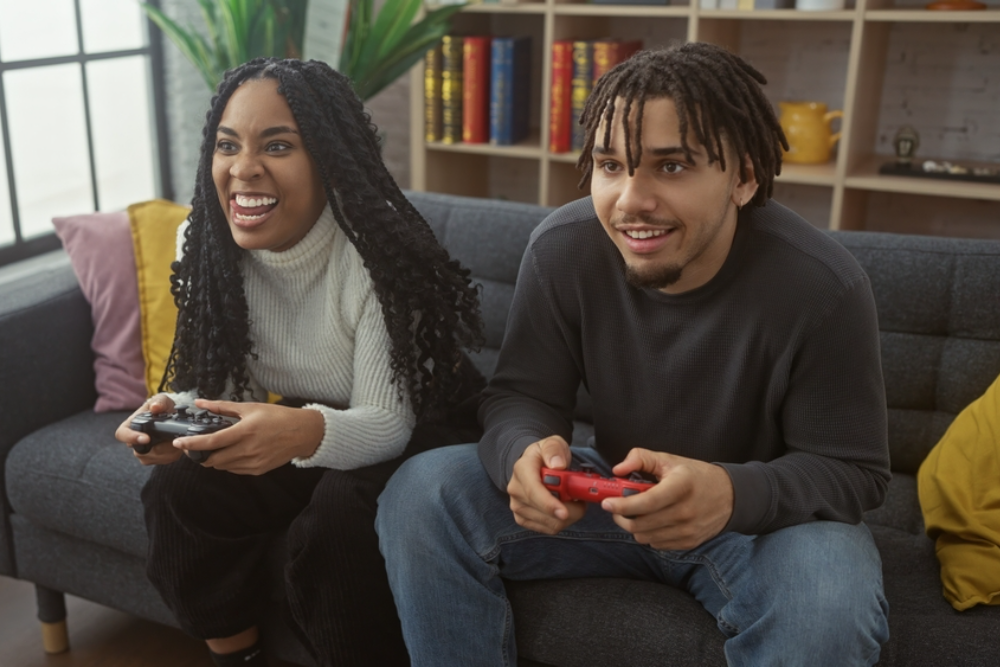
The workday ends, the notifications keep piling up, and the weight of responsibilities refuses to clock out. For couples grinding through demanding schedules and daily pressure, finding a real way to decompress together — not just exist in the same room — has become one of the quieter challenges of modern life. The answer, for a growing number of couples, is something long dismissed as a solo escape— gaming.
What once carried the stigma of antisocial behavior has quietly become one of the most validated tools for stress relief and relationship building. A 2025 global report from the Entertainment Software Association found that roughly 77 percent of players worldwide said gaming helped them feel less stressed, with 70 percent noting a drop in anxiety. Those numbers are not small. They point to something real — and couples who play together are starting to feel exactly what that means.
Why gaming works when nothing else does
When the brain engages in cooperative play, it enters a state of focused attention that interrupts the body’s stress response. Cortisol levels begin to drop. The nervous system, locked for hours in low-level alertness, finally finds room to reset. University of Washington researchers confirmed in 2025 that gaming during stressful periods was strongly linked to positive outcomes for both physical and mental health — a finding that carries particular weight for couples navigating shared financial, professional, and community-level pressures.
There is also a neurological side to what happens when two people play together. Research shows that couples engaged in cooperative tasks develop similar brain wave patterns in regions tied to emotional processing. Oxytocin — the bonding hormone — sees more sustained elevation during shared activity than during conversation alone. Playing together does something that simply talking cannot.
Gaming as a new kind of date night
Relationship therapists have increasingly pointed to shared hobbies as one of the most underrated factors in long-term satisfaction. Couples who regularly pursue common goals report stronger connection and greater resilience during conflict. Co-op titles like *It Takes Two* and *Split Fiction* are built entirely around partnership — requiring players to communicate, adapt, and trust each other’s instincts. Those moments, therapists, carry meaning well beyond the screen.
Even casual titles with no learning curve produce the same bonding effects. The entry point for couples gaming has never been lower, and the range of experiences now spans high-energy competition to quiet, meditative world-building that feels more like a shared conversation than a game.
The stress connection runs deeper than fun
For communities carrying a heavier daily stress load — where economic strain and systemic pressure accumulate without a real off-switch — accessible, low-cost recovery is not a luxury. It is a health need. Gaming requires no gym membership, no reservation, and no babysitter. It delivers measurable relief on a Tuesday night from a couch.
Chronic stress elevates inflammation, disrupts sleep, and raises cardiovascular risk over time. Any consistent practice that interrupts that cycle and introduces positive emotional stimulation functions, clinically speaking, as intervention. Shared gaming does exactly that — in ways that passive leisure like separate scrolling or background television simply does not. Research published in 2025 in *Technology, Mind and Behavior* linked gaming directly to improved sense of belonging and social health, two factors that buffer couples against the outside pressures quietly eroding their connection.
Making it work without overcomplicating it
The most common objection is the skill gap — one partner games, the other never has. That gap, relationship experts point out, is itself an opportunity. Learning something new together activates the same bonding mechanisms as any shared adventure, and the patience shown in those early sessions builds trust that extends far past the game.
Setting even thirty minutes of dedicated play a few evenings a week creates a ritual — and rituals matter. They signal priority. They say— this time belongs to us. In a world competing relentlessly for attention, choosing to put the phone down and share something playful with a partner is a quiet, powerful act. The controllers do not need to be expensive. The game does not need to be complex. Both people just have to show up — and let the rest of the day wait outside.