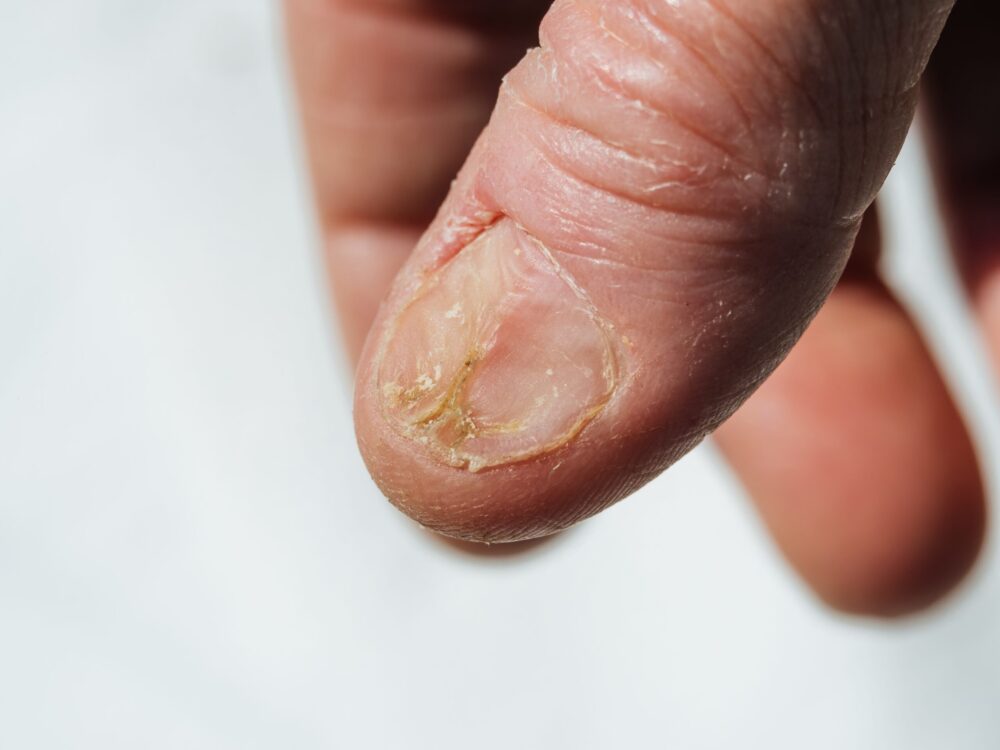
Most people approach nail changes the way they approach minor physical inconveniences generally, with watchful waiting, topical products, and the quiet hope that whatever has changed will change back on its own with time. That approach is appropriate for most nail complaints, which are cosmetic in origin and temporary in nature. It is less appropriate for the subset of changes that reflect conditions developing in systems well removed from the hand, conditions that happen to express themselves in this tissue because it is sensitive enough to register them.
Knowing which changes fall into which category is not about inducing anxiety around every chipped edge or dry cuticle. It is about calibrating the threshold at which a dermatology visit is the right next step rather than another product purchase. The following seven changes represent that threshold more reliably than most people who experience them realize.
1. Dark vertical streaks in the plate
A new or widening dark band running from the matrix to the free edge, particularly in individuals without naturally darker pigmentation, warrants evaluation by a dermatologist without extended delay. While the majority of these bands are benign, a small proportion represent subungual melanoma, a form of skin cancer originating beneath the plate, with a substantially better prognosis at early stages than at late ones.
2. Significant nail pitting across the surface
Small depressions scattered across the plate surface are one of the most reliable visible signs of psoriasis and can appear before any skin manifestation of the condition. Identifying pitting early opens the door to earlier diagnosis of a systemic inflammatory disease with implications that extend well beyond the skin.
3. Horizontal grooves crossing the full plate width
These grooves, known as Beau’s lines, form when the matrix temporarily reduces production in response to significant physiological stress. Their presence indicates that something meaningful happened to the body at a calculable point in the past, whether severe illness, major surgery, chemotherapy, or a significant nutritional deficit.
4. Spoon-shaped curving of the plate edges
When the edges curl upward rather than following the gentle natural arc of the fingertip, the change is associated with iron-deficiency anemia and occasionally with hemochromatosis. Either condition benefits from earlier rather than later diagnosis and targeted treatment.
5. Fingertip clubbing
Progressive broadening of the fingertip with a convex arc of the plate over the rounded tip is associated with chronic low oxygen states tied to lung and cardiac conditions. It develops gradually enough that early stages are often unnoticed by the person experiencing them.
6. Persistent yellow or green nail discoloration
A yellow appearance most frequently indicates fungal infection, which is treatable but rarely resolves without targeted antifungal therapy. Green or black discoloration tends to reflect bacterial colonization beneath the plate following trauma. Neither should be managed indefinitely with topical products without a clinical assessment.
7. Changes accompanied by pain or spread
Any change to nail tissue that is accompanied by pain, bleeding, swelling of the surrounding tissue, or spread to adjacent nails warrants prompt evaluation rather than continued observation. These features elevate the probability that what appeared to be a localized issue reflects something requiring treatment beyond what over-the-counter options can provide. A prompt dermatology visit in response to any of these seven signals is not an overreaction. In most cases it is the decision that most improves the outcome, either by ruling out something serious or by catching something treatable at the stage when treatment is most effective.
The nail is one of the few body structures that is continuously produced and continuously visible. Using what it shows as a regular part of personal health awareness costs nothing and can occasionally prompt a clinical conversation that matters considerably more than any product applied to the outer surface. That conversation, when it happens early enough, is frequently the one that changes the outcome.