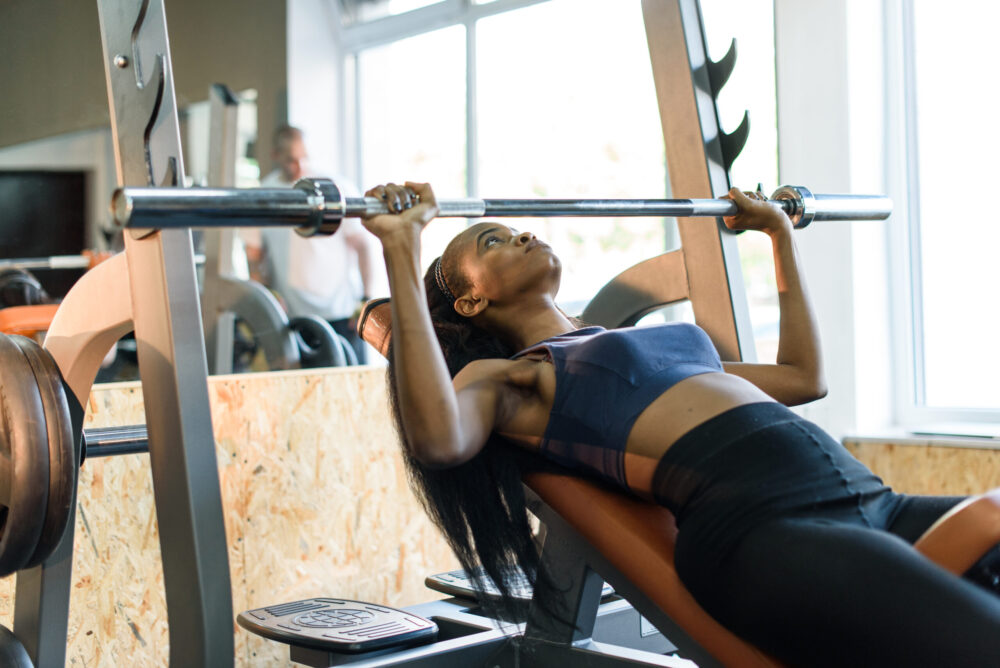
When Elisabeth Bradley walked into the weight room at San Diego State University for the first time, she was the only woman there. Surrounded by muscular men and unsure of what she was doing, she quietly retreated to the cardio area a decision made by countless women every day in gyms across the country.
Bradley had been inspired to try strength training after following a woman documenting her fitness transformation on social media, one barbell at a time. But the reality of the gym floor quickly overwhelmed that motivation. The feeling of being watched, of not belonging, of potentially looking foolish in a space that did not feel designed for her it was enough to send her in the opposite direction.
Her experience is far from unique, and health experts say it represents a real public health problem worth solving.
What the research says about women and resistance training
The National Institutes of Health recommends that all adults, regardless of gender, engage in resistance training at least twice a week. That can include free weights, weight machines, resistance bands or bodyweight movements like squats and pushups any activity that requires the muscles to work against a physical force.
The benefits are well documented. Resistance training helps prevent heart disease, lowers blood pressure and supports long-term mobility, according to Brad Schoenfeld, a professor of exercise science at Lehman College in New York City. For women specifically, the case is even more compelling. Strength training helps guard against osteoporosis and age-related muscle loss two conditions women are disproportionately vulnerable to as they get older.
Despite all of this, many women still gravitate toward cardio and group fitness classes, leaving the weight room largely dominated by men.
Why so many women stay away
The barriers are both practical and deeply psychological. Daisy Arauza, a 30-year-old mother of two in Menifee, California, says she would like to join a gym for strength training but holds back because of self-consciousness about her body and uncertainty about gym etiquette. The mental image of a gym populated by already-fit people makes her feel she has to meet a certain standard before she even walks through the door.
There is also a persistent and outdated myth that lifting weights will make women look bulky. Schoenfeld is clear on this point: it is genuinely difficult for most people to build large amounts of muscle, and especially so for women, who have significantly lower levels of testosterone than men. Reducing training intensity, he adds, quickly reverses any muscle gain a woman might not want.
Michelle Segar, a behavioral scientist at the University of Michigan who studies exercise habits, says the gym environment itself carries much of the blame. When women feel out of place or constantly aware of how they are being perceived, the focus shifts away from how exercise makes them feel which is the very thing most likely to keep them coming back.
What gyms and communities can do differently
After her uncomfortable early experience, Bradley eventually connected with a fellow student who helped her learn the basics of weightlifting. That single act of inclusion changed everything. She went on to found Girl Gains, a female weightlifting club that now has dozens of chapters at colleges across the country.
The organization is built on the idea that strength training belongs to everyone, and that women thrive in the weight room when they feel supported rather than scrutinized. Bradley is also quick to point out that strength training does not replace other forms of exercise it enhances them. Building muscle makes runners faster, supports Pilates practice and improves overall athletic performance.
Some women find that separating from mixed-sex environments helps. At Goddess Gym, a women only facility in Peterborough, England, members describe a sense of community and ease that they struggled to find in traditional gyms. Others point to practical needs: Michelle Kozak of Phoenix canceled her gym membership entirely when her facility stopped offering on-site child care, removing the one thing that made regular attendance possible for her as a mother of two young children.
Experts agree the solution requires both better education and more welcoming spaces because the health benefits waiting on the other side are too significant to ignore.