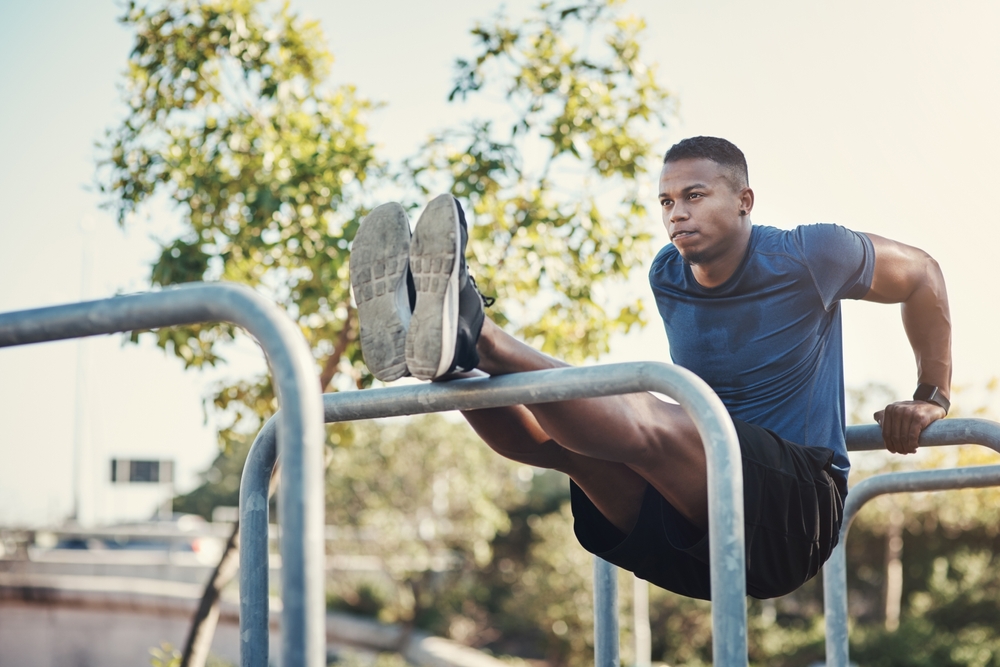
No machines, no membership, no excuses — just calisthenics, bars, bodyweight, and a level of functional strength most gym routines never reach.
There is a certain honesty to outdoor training. No mirrors, no machines calibrated to make the movement easier, no air conditioning softening the effort. Just a man, a set of bars, and the full weight of his own body working against gravity. That is not a limitation. That is the point.
Calisthenics — the practice of using bodyweight as resistance — has been a foundation of physical conditioning for centuries. What is experiencing a genuine resurgence today is the outdoor version of it— training in parks, on public bars, in open spaces where the environment itself becomes part of the workout. The results, for those who commit to it, are difficult to argue with.
What Makes Calisthenics Different
The core distinction between calisthenics and conventional gym training is the nature of the resistance. Machines isolate individual muscles and guide movement along a fixed path. Bodyweight training demands that the entire body work as a coordinated system — stabilizing, balancing, and generating force simultaneously.
This produces a different quality of strength. The kind that transfers. A person who can control their own bodyweight through a full range of motion is building functional capacity that shows up in everyday life — in posture, in injury resistance, in the ability to move well for decades.
Calisthenics also develops proprioception, the body’s awareness of its position in space, at a level that machine-based training rarely achieves. That neurological adaptation is a significant component of long-term athletic longevity.
The Outdoor Advantage
Taking calisthenics outside adds a layer of benefit that an indoor setting cannot replicate. Uneven surfaces, variable temperatures, and natural light all engage the body’s adaptive systems in ways that controlled gym environments do not.
Research consistently links outdoor physical activity to greater workout enjoyment, higher rates of adherence, and improved mood both during and after exercise. People who train outside tend to go longer, push harder, and return more consistently than those confined to indoor settings.
The mental component is equally significant. Training in open air, with natural surroundings and real ambient conditions, reduces cortisol levels and supports focus in ways that fluorescent-lit gym floors simply do not.
Core Movements That Deliver Results
A well-structured calisthenics routine does not require elaborate programming. A handful of fundamental movements, performed consistently and with progressive intensity, build comprehensive strength across the entire body
- Push-ups — chest, shoulders, triceps, and core
- Pull-ups and bar rows — back, biceps, and grip strength
- Dips — triceps, chest, and shoulder stability
- Leg raises — deep core and hip flexor strength
- L-sits and tuck holds — full-body tension and control
Mastering these movements and their progressions provides a training foundation that rivals — and in many respects surpasses — what most gym programs deliver.
Getting Started Without Overwhelm
The most common mistake beginners make with calisthenics is chasing advanced movements before building the foundational strength to support them. Consistency at the basics produces faster long-term progress than sporadic attempts at impressive skills.
A sustainable starting point looks like this
- Train three to four days per week with at least one rest day between sessions
- Focus on clean form over volume in the first two months
- Progress by adding reps, sets, or difficulty variations — not by rushing to harder movements
- Use a local park, outdoor gym, or any accessible set of bars
- Track progress simply — a log or phone app is enough
The barrier to entry is low. The ceiling is remarkably high.
The Bigger Picture
The man on the bars is not just building muscle. He is building a relationship with his own physical capacity — one that does not depend on a gym being open, a machine being available, or a membership being affordable. That independence is its own form of strength.
Outdoor calisthenics returns fitness to its most essential form. Body, gravity, intention. Everything else is optional.