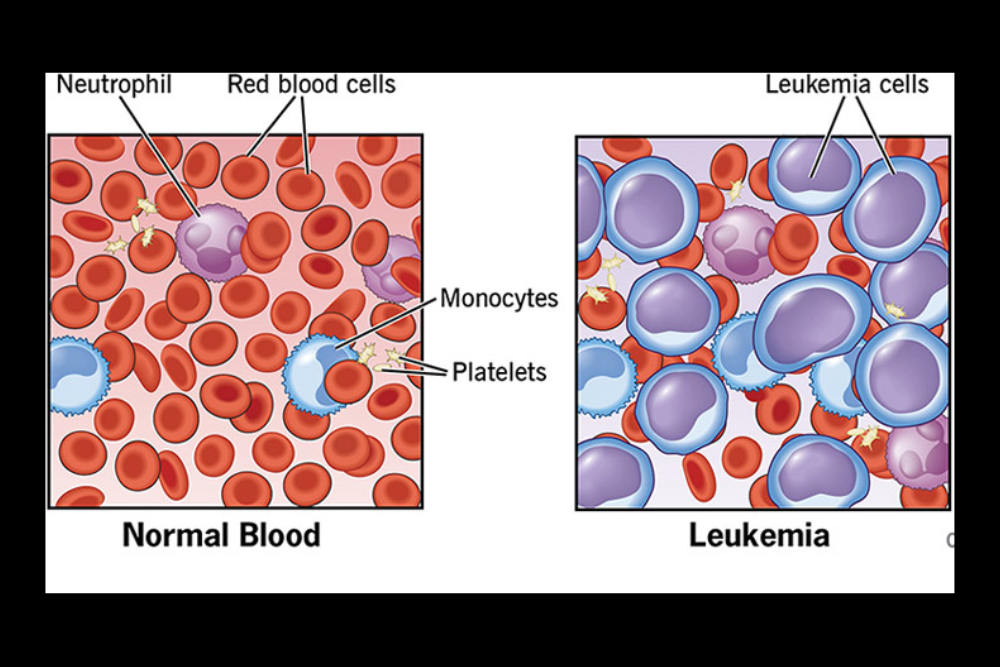
Leukemia is a cancer that begins not in an organ or a tumor, but in the bone marrow itself, the soft tissue buried inside bones where every blood cell in the body gets its start. When the DNA of a single developing cell mutates, something breaks in the system. That cell starts multiplying without stopping, producing copies of itself that are abnormal and immature. These cells, called leukemia cells, flood the bone marrow and crowd out the healthy red blood cells, white blood cells and platelets the body depends on.
Without enough healthy blood cells, the consequences spread fast. Tissues stop receiving adequate oxygen. The immune system loses its ability to fight off infections. The blood stops clotting properly. And because leukemia doesn’t form a solid tumor, it won’t show up the way most cancers do on a scan. It hides in the bloodstream and bone marrow, which makes early detection harder and treatment more complex.
The four types driving the numbers
Leukemia is classified in two ways: by how fast it progresses and by which type of blood cell it originates from. That framework produces four primary diagnoses.
Acute lymphocytic leukemia, known as ALL, is the most common leukemia in children and young adults. Acute myelogenous leukemia, or AML, is the dominant form in adults, particularly those over 65. Both acute forms move quickly. Without prompt treatment, they become life-threatening within weeks.
The chronic forms move more slowly. Chronic lymphocytic leukemia, CLL, is the most common chronic leukemia in adults and can go undetected for years. Chronic myelogenous leukemia, CML, follows a similar pattern. People living with chronic leukemia may feel fine for a long stretch before any symptoms emerge, which is part of what makes the disease so quietly dangerous.
Leukemia as a whole accounts for 3.2% of all new cancer cases in the United States, ranking it as the 10th most common cancer nationally.
Leukemia symptoms most people miss
Because chronic leukemia can develop without obvious warning signs, many people live with it before ever receiving a diagnosis. Even acute leukemia, though faster-moving, can begin with symptoms easy to attribute to something else.
Fatigue that doesn’t improve with rest, frequent infections, unexplained weight loss, night sweats, pale skin and pain under the left side of the ribs are among the most reported early signs. Unusual bruising, bleeding gums and tiny red spots on the skin, a condition called petechiae, are also common. Swollen lymph nodes sometimes appear in the neck, underarms or groin.
A routine blood count is often what catches leukemia first. Abnormally high white blood cell levels prompt further testing, typically a bone marrow biopsy, which confirms the diagnosis.
How leukemia treatment works
Treatment depends heavily on the specific type of leukemia, the patient’s age and overall health, and how far the disease has progressed. Most treatment plans involve some combination of chemotherapy, targeted therapy, immunotherapy, radiation or a stem cell transplant.
Chemotherapy remains the most widely used approach. Targeted therapy goes after specific proteins or genes inside leukemia cells, leaving healthy cells less affected. Immunotherapy works by training the immune system to recognize and attack the cancer. A newer approach, CAR T-cell therapy, takes a patient’s own T-cells, engineers them to target leukemia and reintroduces them into the body.
Treatment is often structured in phases: an induction phase to push the cancer into remission, a consolidation phase to eliminate any remaining cells, and a maintenance phase lasting roughly two years to prevent relapse.
Leukemia survival rates, by the numbers
Survival rates vary sharply by type. CLL carries the strongest five-year survival rate at 87.2%, followed by CML at 70.6% and ALL at 69.9%. AML is the most aggressive, with a five-year survival rate of 29.5%.
While there is no guaranteed cure, long-term remission is possible and increasingly common. The mutation profile of the leukemia cells, the patient’s age and health at diagnosis, and the speed of response to treatment all factor into what comes next.